Life in hiding in the Secret Annex
Diary of Anne FrankLife in hiding in the Secret Annex was a condition of enforced confinement in which ordinary acts—walking, washing, listening, even looking out a window—were governed by the danger of discovery. In Anne Frank’s diary, the hiding place is not merely a shelter: it is a cramped daily world formed by anti-Jewish persecution, practical rules, fear, arguments, fragile routines, and the effort to preserve an inner life. The account moves between the minute management of safety and Anne’s larger questions about Jewish identity, belonging, faith, and the future.
From persecution to concealment
The decision to hide arose from the escalating restrictions imposed on Jews in the Netherlands after the German occupation. The diary recalls how a sequence of decrees narrowed daily life: Jews had to wear the yellow star, give up their bicycles, shop only during specified hours, and avoid public transport, entertainment, sports facilities, and the streets at night. These measures turned public space into a system of prohibitions. The family’s earlier anxiety had also been sharpened by the persecution of relatives in Germany: after the 1938 pogroms, Anne’s two maternal uncles fled to North America, while her elderly grandmother came to live with the family.
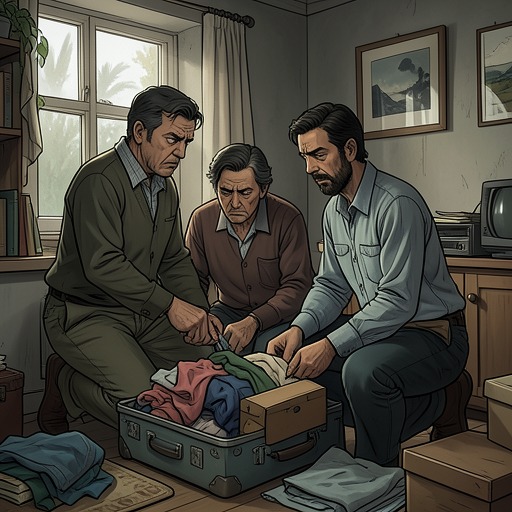
The move into hiding had been planned for July 16, but Margot’s call-up notice forced the family to bring it forward by ten days. Anne describes the departure in pouring rain, with her parents and herself carrying schoolbags and shopping bags filled with belongings. The family had already been moving furniture and clothing out of their apartment for months, but the sudden change meant the rooms were left less orderly than intended. The hiding place was in her father’s office building, a choice that brought the family into a concealed space embedded within the working city rather than to a separate refuge.
Anne maps the entrance and interior with the attention of someone learning the boundaries of a new world. A plain gray door at the landing led to the Secret Annex at the back of the building; beyond it were a steep staircase and a narrow hallway opening toward the Frank family’s living quarters. The description makes the concealment both tangible and precarious: the rooms were hidden behind an ordinary door, yet the residents’ safety depended on the outside world not discovering what lay behind it.
Rules, routines, and the building
From the beginning, the residents feared that neighbors might hear or see them. Anne and her father stitched scraps of fabric into crooked curtains and tacked them over the windows, where they were to remain until the family could leave hiding. The curtains were improvised from materials of varying shapes, quality, and pattern; their purpose was practical, but their handmade appearance also registered how abruptly ordinary domestic life had been remade around concealment. The family had books and planned to acquire games, but could not look out of the windows or go outdoors, and had to keep quiet so that people downstairs would not hear them.
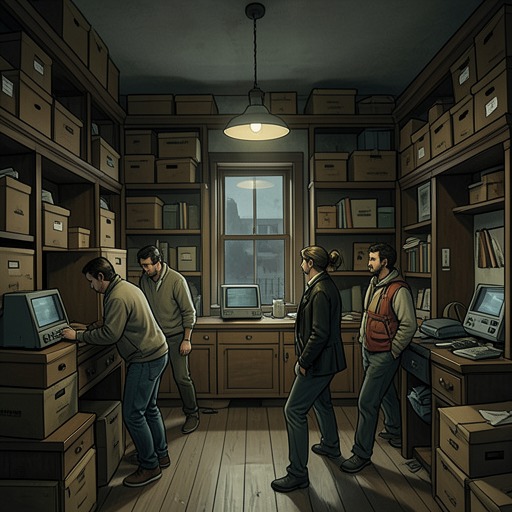
The building imposed a shifting timetable. Before the office staff arrived, sounds carried more readily from the upper rooms to the warehouse below. During these hours the residents could not use running water or the flushing toilet, walk about, or make noise. Such rules made even routine bodily needs dependent on the working day of people outside the Annex. Anne’s later description of an ordinary evening and night shows how the diary made these repeated, constrained hours legible to readers unfamiliar with hiding.
The office building was also a source of continuous uncertainty. In one early scare, a doorbell rang at eight o’clock, and Anne immediately feared that someone had come to take the residents away. The others reassured her that the sound might have come from pranksters or the mailman, but the episode shows how an ordinary interruption could be transformed by the circumstances into an apparent threat. The Westertoren clock offered a contrasting sound: its chimes marked each quarter hour, and while her parents and Margot had not grown used to them, Anne found them reassuring, especially at night. The same confined world could make a bell frightening and a clock comforting.
Intrusions and tightened security
Burglary repeatedly threatened the already fragile boundary between the Annex and the outside world. On one occasion, Peter discovered that both the warehouse door and the street door were open. He reported this to Otto, who went to the private office, tuned the radio to a German station, and locked the door. The residents followed their emergency instructions: they did not wash or use water, kept quiet, dressed by eight, and avoided the bathroom. They had slept through the incident, but were left waiting for news until an office worker came upstairs at eleven-thirty. The burglars had forced the outside and warehouse doors with a crowbar; finding little to steal, they tried the next floor. The episode reveals how a break-in below them could bring the concealed household to a standstill above.
A later attempted break-in brought the danger closer. Anne recognized from the men’s conversation that their explanation was a pretext and correctly concluded that the warehouse was being broken into. Otto, Hermann, and Peter went downstairs, while the others remained in the Annex. Anne later identified the police rattling at the bookcase as one of the moments when she had been most afraid. The concealed entrance itself, the safeguard on which the residents depended, had become a point at which discovery seemed possible; Anne’s attachment to her diary was bound up with that threat, since its loss felt to her inseparable from her own.
The incident led to concrete changes in the household’s security arrangements. Fritz was to work in the bathroom, Peter was assigned to patrol the house between eight-thirty and nine-thirty, and he was no longer allowed to open his window after someone connected with the warehouse had noticed it. The residents could not flush the toilet after nine-thirty at night. A night watchman, Sleegers, was hired, and a carpenter from the underground was expected to construct a barricade from the residents’ white Frankfurt bedsteads. They also had to consider whether the watchman could be trusted, whether dogs would bark at someone behind the door, and how the barricade should be made. Security was not a settled system but a continuing set of questions, revised after each new vulnerability.
The residents were reminded by these dangers that they were Jews living without ordinary rights, yet burdened with obligations imposed by their circumstances. Anne describes the discipline demanded of them as setting feelings aside, remaining brave, enduring discomfort without complaint, doing what they could, and trusting in God. Her account links the practical rules of concealment to the larger political reality: the household’s enforced stillness was not chosen privacy, but the consequence of being targeted and deprived of freedom of movement.
Unequal confinement and the lives outside
The Annex’s shared confinement did not affect all its residents in the same way. Anne recognized that Peter had a room of his own in which he could work, dream, think, and sleep; she connected this private space to his greater restfulness and to her own restlessness. The difference was not simply one of temperament. In a crowded household where privacy was scarce, access to a room could shape a person’s ability to withdraw and think alone.
Those who helped the residents were also living through the occupation, but from a different position. Anne describes the responsibility carried by Otto’s colleague Victor Kugler as so heavy that at times he could hardly speak from the strain. Johannes Kleiman and Bep Voskuijl cared for the hidden group as well, yet could sometimes put the Annex out of their minds for a few hours or days. They had worries of their own—Kleiman’s health and Bep’s uncertain engagement—but could still go out, visit friends, and continue parts of ordinary life. For the residents, by contrast, tension had not lifted once during their two years inside. The comparison makes the support they received inseparable from the asymmetry between a life that could briefly resume outside and one that remained permanently enclosed.
The diary also records how outside news entered the Annex imperfectly. People coming from outside sometimes brought reports that later proved false, while the residents trusted the radio as a more reliable source. Political arguments among the hidden residents could make matters worse, and Anne objected to quarrelling over politics even as discussion of public events became unavoidable. War reached the Annex through broadcasts, helpers, rumors, and the changing conditions of the occupied country, but never as a complete or disembodied account.
The danger of arrest remained present even when no immediate intrusion occurred. After hearing of the case of Mr. van Hoeven, who had been arrested for hiding Jews, the residents grew more frightened and renewed their efforts to keep quiet. The forced door at his home made the possibility of the police forcing their own entrance feel newly immediate. Anne begins to imagine what might happen, then stops herself from writing it down. The break in the thought is part of the record: fear appears not only in descriptions of events but in what the writer cannot bring herself to set on the page.
Identity, hope, and the diary’s double life
Confinement sharpened the difference between Jewish identity as a personal or communal belonging and Jewishness as an imposed legal category. During the Hanukkah observance that nearly coincided with St. Nicholas Day, the household exchanged a few small gifts and lit candles for only ten minutes because candles were scarce. Hermann made a wooden menorah. The holiday was modest, adapted to the conditions of hiding, but its ritual and shared song made room for Jewish practice within a life otherwise ruled by restrictions.
Anne also records the painful political ambiguity surrounding Jewish refuge. She heard that some people in underground circles believed German Jews who had immigrated to the Netherlands before the war and were later sent to Poland should not be allowed to return after Hitler was gone, despite having been granted asylum. Against this, she expressed her love for the Netherlands and her hope that it could still become her fatherland, after the loss of her earlier home. Her sense of belonging is therefore neither a simple inheritance nor an assured refuge; it is an attachment she continues to affirm amid exclusion and uncertain welcome.
The prospect of liberation changed the emotional horizon of hiding. When the invasion began, Anne felt that friends were on the way. The thought of salvation mattered because the Germans had oppressed and threatened the residents for so long; she also perceived the stakes as extending beyond Jews to the Netherlands and occupied Europe. Margot suggested that Anne might be able to return to school in September or October. The possibility remained uncertain, but it gave the future a concrete shape: not merely survival, but a classroom and a resumed education.
Writing helped Anne hold the extraordinary conditions of the Annex together as an account. She began the diary for herself, but a 1944 broadcast from London by Gerrit Bolkestein, a member of the Dutch government in exile, proposed collecting diaries and letters about suffering under German occupation for public use after the war. Anne decided to make a book from her diary, rewriting and editing it while continuing to keep the original. Her two versions reflect a change in the imagined audience: a private record became, in her own plans, a future public testimony about the Secret Annex.
That literary transformation has a publication history of its own. Anne was thirteen when she began writing and fifteen when forced to stop. When Otto prepared the diary for its initial publication in 1947, he had to keep it short enough for the Dutch publisher’s series. He also omitted passages about Anne’s sexuality, which contemporary publishing conventions did not readily admit, especially in books for young readers, and unflattering passages about his wife and the other residents, out of respect for the dead. Anne herself had written frankly about her likes and dislikes. The published account of hiding therefore passed through distinct stages: Anne’s original diary, her own revision, and her father’s later selection.
Anne did not understand life in hiding only as deprivation. She could describe it as an adventure marked by danger and romance, and treat its privations as material for her diary; she had decided that she would not simply grow into the ordinary domestic life expected of girls. Yet this imaginative reframing did not remove the pressure of reality. She knew that the young were made to confront problems they were not prepared to solve, and that ideals and hopes could be crushed by events. Her determination to cling to her belief in human goodness makes the diary’s hope neither an account of safety nor a denial of danger. It is a conviction maintained inside a life whose routines, relationships, and future remained under threat.